Showing posts with label LDS. Show all posts

Sunday, February 16, 2020

Goal setting

I spoke in the Lynnfield ward today. This is my third time speaking in that ward. Previously I spoke on citizenship in the ward and the restoration. Today I spoke on goal setting. It's a little different now that this is my assigned ward and so I know the congregation a lot better. Goal setting is something that has been on my mind a lot recently for a number of reasons, so I appreciated the opportunity to collect and organize my thoughts. I thought things came together okay, although my delivery had some bumps. I made the cardinal sin of going over time, which I felt bad about (especially since I actually had plenty of time). 

Hopefully somebody found the talk helpful. I used Wall-e as a framing device.
Image result for Wall-e


Here's the notes, but the formatting is off due to copying and pasting. I suggest you look at the Google doc instead.

Sunday, June 23, 2019

Hope in the Latter-days

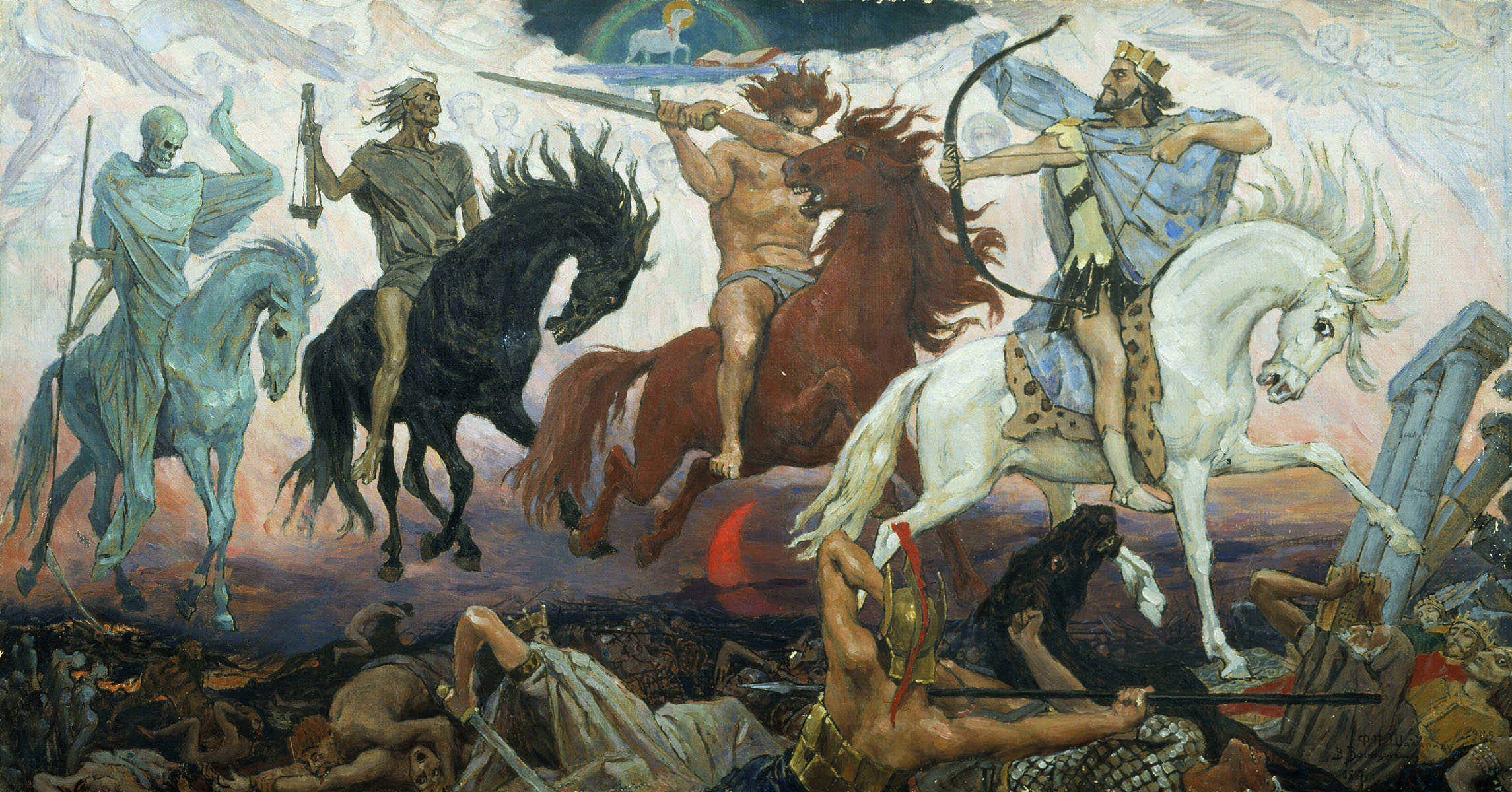
I spoke today in the Billerica Ward. I had "what does it mean to be a saint in the last days" as my assigned topic. While there's no shortage of material about the last days, I definitely wanted to make sure I stayed applicable and useful for the congregation rather than speculative and sensational. I also didn't have time to binge-watch Good Omens. In the end, and at the suggestion of my wife, the material came together around hope: gaining hope, sharing hope, and nurturing hope.


Image result for desolation of daniel four horsemen apocalypse

I didn't write out everything about my talk due to preparation time constraints and that I tend to just read my words when I do that. I did collect various notes, quotes, and scriptures and share the outline below. Most of the main ideas came from Elder D. Todd Christofferson's talk titled Preparing for the Lord's Return.


Wednesday, August 22, 2018

Self-Reliance Redo

I spoke this past Sunday in the Methuen Ward on self-reliance. I used the text of the last talk I gave on self-reliance, only I stripped it down to bullet points so I would not read it. That meant I did not have to talk so fast, but it also means I rambled a bit at times and probably used filler words. Oh well. One poor individual had actually been in Billerica when I gave the talk the first time. He only recognized the first Indiana Jones story and not the rest of the talk. I guess that's good that I use a memorable introduction, right?


You can find the notes I used below, or look at the Google Doc.

Sunday, May 20, 2018

The Restoration

I spoke in the Lynnfield Ward today. I received the assigned topic of "the Restoration" and collected a number of eclectic thoughts to put together my talk. For some reason I got really nervous giving this talk. I think the topic ended up coming together in a good way, but my delivery didn't work too well. It happens. I'm copying my notes below.


Sunday, February 18, 2018

Overcoming trials of faith

I spoke today in the Revere 2nd Ward. I had President Uchtdorf's talk from a few years ago, Come, Join with Us, as a text with which to start. I think that talk had a lot of great messages inside it, but I struggled over the last few weeks to make it my own. Eventually I decided to leverage the story of Corianton to try and teach some principles.

The previous speaker spoke on lessons from Liberty Jail, and it was not until I heard her talk that things really came together in mind for my own talk. She drew from a number of sources, but probably most directly from Elder Holland's CES Fireside Lessons from Liberty Jail. I found it interesting that she quoted Alma 41:10 from right in the middle of the counsel to Corianton I was about to use as the main mechanism for my talk.

In the end I only had about ten minutes to give my talk, maybe less. As usual, I had over-prepared material for even a full amount of time. So I cut my talk in half and tried to sew it all together on the fly. It didn't go horribly, but I definitely rambled a bit here and there.

Full disclosure: so far I haven't been recycling talks. 

In addition to seeing the text below, you can look at the Google Doc.

Sunday, November 19, 2017

Self-reliance

I spoke today in my home ward as the high council speaker. I had self-reliance as the topic for my talk. On the one hand, I had plenty to say since I've had my head in that space for the last couple of years. On the other hand, I had too much to say for the same reason. I wanted to create something I could share with others and I wanted to make sure I said it right, so I wrote everything out. I think that allowed me to say the right things, but then I also read too much from my talk and spoke too fast. I opened with a reference from Indiana Jones.
Google Doc for text (also copied below):

Sunday, August 20, 2017

Conflict and the gospel

I spoke in the Methuen Ward today. I received "Captain Moroni being angry a lot even though he is the most righteous man on the planet" as my original topic, but proposed modifying it slightly to "conflict in the gospel." I found the topic very interesting academically and theologically, but worried about my ability to appropriately convey it through a Sacrament meeting talk. My preferred medium for this topic would be a Sunday School or Quorum lesson, but oh well.


Per my MO, I over-prepared in general and under-prepared my conclusion. One of my problems is that I know exactly what I will have already said at the beginning of my talk (which is nothing), but for the end of my talk I cannot know ahead of time what I had to cut and can no longer reference while concluding. I still think I can prepare the conclusion a bit better for next time.

I did not manage my time particularly well. Ironically, that meant I cut out most of my text about Moroni. Luckily, the previous speaker had already hit two of my most important points from that section of my talk. In fact, he gave a really good talk on Christ-like leadership, and the two talks worked really well together. At least in my head as I was listening to his words.

You can see my notes for the talk at this link, or I have also posted them below.

Sunday, July 16, 2017

Pioneering and the search for temple worship

I spoke in the Lynn branch today of the North Shore Stake. They're in-between buildings over in Lynn, so they currently meet in the Lynnfield building. I gave the talk in Spanish. I probably could have use a couple more run-throughs of practicing the pronunciation, but I think it went fine. The branch members were very gracious and complimentary, which I appreciated. I didn't feel like it came together how I originally envisioned the topic, but it fit perfectly into the time I ended up having to deliver it. After the talk I went outside and caught a photo of a couple of turkeys:


Sunday, March 19, 2017

Teaching others to recognize the Spirit

Text from a talk I gave today in the Revere 2nd ward:

In Star Wars Episode VII: The seasoned veteran Han Solo discusses strategy for infiltrating an enemy base with the young, ex-stormtrooper Finn:

Han Solo: What was your job when you were based here?
Finn: Sanitation.
Han Solo: Sanitation? Then how do you know how to disable the shields?
Finn: I don't. I'm just here to get Rey.
Han Solo: People are counting on us. The galaxy is counting on us.
Finn: Solo, we'll figure it out. We'll use the Force.
Han Solo: That's not how the Force works!


Finn has some learning to do about the “mystical energy field that controls [his] destiny” over the next couple of movies. I like Star Wars analogies, but won’t be submitting you to any more during this talk.

Personal revelation as received through the Holy Ghost forms a rock upon which the church stands, but what does that even mean?

Matthew 16 (after feeding the 4k, warn against doctrine of Pharisees and Sadducees):
13 ¶ When Jesus came into the coasts of Cæsarea Philippi, he asked his disciples, saying, Whom do men say that I the Son of man am?
14 And they said, Some say that thou art John the Baptist: some, Elias; and others, Jeremias, or one of the prophets.
15 He saith unto them, But whom say ye that I am?
16 And Simon Peter answered and said, Thou art the Christ, the Son of the living God.
17 And Jesus answered and said unto him, Blessed art thou, Simon Bar-jona: for flesh and blood hath not revealed it unto thee, but my Father which is in heaven.
18 And I say also unto thee, That thou art Peter, and upon this rock I will build my church; and the gates of hell shall not prevail against it.

Christ built his church on the rock of revelation, but can we define that any better? From that account we know it does not come from flesh and blood, and that it comes from God (like everything does). Some people might say a revelation comes from “an undigested bit of beef, a blot of mustard, a crumb of cheese, a fragment of an underdone potato.“

How can we recognize it in our own lives? In answer to the question, “How do we recognize the promptings of the Spirit?” President Gordon B. Hinckley read Moroni 7:13, 16–17

13 But behold, that which is of God inviteth and enticeth to do good continually; wherefore, every thing which inviteth and enticeth to do good, and to love God, and to serve him, is inspired of God.
16 For behold, the Spirit of Christ is given to every man, that he may know good from evil; wherefore, I show unto you the way to judge; for every thing which inviteth to do good, and to persuade to believe in Christ, is sent forth by the power and gift of Christ; wherefore ye may know with a perfect knowledge it is of God.
17 But whatsoever thing persuadeth men to do evil, and believe not in Christ, and deny him, and serve not God, then ye may know with a perfect knowledge it is of the devil; for after this manner doth the devil work, for he persuadeth no man to do good, no, not one; neither do his angels; neither do they who subject themselves unto him.

Then President Hinckley said: “That’s the test, when all is said and done. Does it persuade one to do good, to rise, to stand tall, to do the right thing, to be kind, to be generous? Then it is of the Spirit of God. …
“If it invites to do good, it is of God. If it inviteth to do evil, it is of the devil. … And if you are doing the right thing and if you are living the right way, you will know in your heart what the Spirit is saying to you.
“You recognize the promptings of the Spirit by the fruits of the Spirit—that which enlighteneth, that which buildeth up, that which is positive and affirmative and uplifting and leads us to better thoughts and better words and better deeds is of the Spirit of God” (Teachings of Gordon B. Hinckley, 260–61).

So, the Spirit is not flesh and blood, comes from God, persuades us to do good, and does not invite us to do evil. That’s progress, but still not a something I can really get behind as a definition. How do I know what it sounds like?

1 Kings 19:11-12 (Elijah hiding from Jezebel, goes to Horeb, feels lonely and depressed):

11 And he said, Go forth, and stand upon the mount before the Lord. And, behold, the Lord passed by, and a great and strong wind rent the mountains, and brake in pieces the rocks before the Lord; but the Lord was not in the wind: and after the wind an earthquake; but the Lord was not in the earthquake:
12 And after the earthquake a fire; but the Lord was not in the fire: and after the fire a still small voice.

We get a few more negative definitions here: the Spirit was not in the strong wind, the earthquake, or the fire. However, we also get a positive definition: a still small voice. So the Spirit is a still small voice that entices us to do good.

“The Spirit does not get our attention by shouting or shaking us with a heavy hand. Rather it whispers. It caresses so gently that if we are preoccupied we may not feel it at all. (No wonder that the Word of Wisdom was revealed to us, for how could the drunkard or the addict feel such a voice?)
“Occasionally it will press just firmly enough for us to pay heed. But most of the time, if we do not heed the gentle feeling, the Spirit will withdraw and wait until we come seeking and listening and say in our manner and expression, like Samuel of ancient times, ‘Speak [Lord], for thy servant heareth.’ (1 Sam. 3:10.)” (“The Candle of the Lord,” Ensign, Jan. 1983, 53).

Do you remember that story? 1 Samuel 3:

1 And the child Samuel ministered unto the Lord before Eli. And the word of the Lord was precious in those days; there was no open vision.
2 And it came to pass at that time, when Eli was laid down in his place, and his eyes began to wax dim, that he could not see;
3 And ere the lamp of God went out in the temple of the Lord, where the ark of God was, and Samuel was laid down to sleep;
4 That the Lord called Samuel: and he answered, Here am I.
5 And he ran unto Eli, and said, Here am I; for thou calledst me. And he said, I called not; lie down again. And he went and lay down.
6 And the Lord called yet again, Samuel. And Samuel arose and went to Eli, and said, Here am I; for thou didst call me. And he answered, I called not, my son; lie down again.
7 Now Samuel did not yet know the Lord, neither was the word of the Lord yet revealed unto him.
8 And the Lord called Samuel again the third time. And he arose and went to Eli, and said, Here am I; for thou didst call me. And Eli perceived that the Lord had called the child.
9 Therefore Eli said unto Samuel, Go, lie down: and it shall be, if he call thee, that thou shalt say, Speak, Lord; for thy servant heareth. So Samuel went and lay down in his place.
10 And the Lord came, and stood, and called as at other times, Samuel, Samuel. Then Samuel answered, Speak; for thy servant heareth.

Let’s look at what we can learn from this story. Samuel lived righteously, so he gave himself the opportunity. He heard a voice and he did not recognize it at first. I note that he got more than one shot here! We want to get so that we can recognize and respond at the first prompting, but the Lord helps us learn and understands. I’ve found this in my own life.

I also find Eli’s behavior interesting here. First, the teaching opportunity didn’t come when it was convenient. It didn’t even come when Eli was awake! He also missed it the first couple of times, pretty understandably I would say. But he got it in the end, and helped Samuel along the path to becoming a prophet.

Aside from working in the tabernacle and adopting a future prophet, what can we do to help others around us to learn to recognize the Spirit?

“You cannot force spiritual things. Such words as compel, coerce, constrain, pressure, demand, do not describe our privileges with the Spirit. You can no more force the Spirit to respond than you can force a bean to sprout, or an egg to hatch before its time. You can create a climate to foster growth, nourish, and protect; but you cannot force or compel: you must await the growth” (Boyd K. Packer, “The Candle of the Lord,” Ensign, Jan. 1983, 53).

That patience is extremely difficult, especially for those we love and care for. It might be tempting to use a shortcut and attempt to manipulate people into feeling the Spirit.

President Howard W. Hunter offered this counsel: “Let me offer a word of caution. … I think if we are not careful … , we may begin to try to counterfeit the true influence of the Spirit of the Lord by unworthy and manipulative means. I get concerned when it appears that strong emotion or free-flowing tears are equated with the presence of the Spirit. Certainly the Spirit of the Lord can bring strong emotional feelings, including tears, but that outward manifestation ought not to be confused with the presence of the Spirit itself” (The Teachings of Howard W. Hunter, 184). The Spirit of the Lord always edifies.

So we cannot force people to feel the Spirit and we should not confuse strong emotions with the Spirit (they’re orthogonal). So what do we do?

I like how Alma taught it to the poor Zoramites on the hill Onidah:

Alma 32
27 But behold, if ye will awake and arouse your faculties, even to an experiment upon my words, and exercise a particle of faith, yea, even if ye can no more than desire to believe, let this desire work in you, even until ye believe in a manner that ye can give place for a portion of my words.
28 Now, we will compare the word unto a seed. Now, if ye give place, that a seed may be planted in your heart, behold, if it be a true seed, or a good seed, if ye do not cast it out by your unbelief, that ye will resist the Spirit of the Lord, behold, it will begin to swell within your breasts; and when you feel these swelling motions, ye will begin to say within yourselves—It must needs be that this is a good seed, or that the word is good, for it beginneth to enlarge my soul; yea, it beginneth to enlighten my understanding, yea, it beginneth to be delicious to me.

That makes sense to me as an engineer and scientist. We can do experiments: plant the seed and see how it goes. If we want to help others, help them plant more seeds, and tell them about your experience with planting seeds.

That scripture also describes how the Spirit feels according to Alma: swelling within your breast, enlargening your soul, enlightening your understanding, and being delicious. That’s pretty close to how I feel the Spirit in my life, but the simplest definition can be found in D&C 50, the Lord’s constitution on teaching:

D&C 50
22 Wherefore, he that preacheth and he that receiveth, understand one another, and both are edified and rejoice together.

I know that I’m feeling the Spirit when I feel edified, when I feel built up. I felt that during my preparation of this talk, [I felt it at points while delivering the talk], and I hope you felt it too.

Conclusion

Sunday, January 15, 2017

Citizenship in the Ward

I spoke in the Lynnfield LDS Ward today. What an amazing ward! While I found many parts of their services edifying, perhaps the most startling was how early their chapel filled up. I showed up about ten minutes early to the building. At my ward, that would be a near-empty chapel, but in Lynnfield the chapel was pretty full and the overflow was already filling up. I almost wanted to ask if the congregation was really full of Mormons, as nobody seemed to abide by "Mormon standard time." In the end they had to open up into the cultural hall.

The other speaker in the program covered the material really well, so I just had to not mess it up too badly. That's always nice. My assigned topic was "reaching out to our community, strengthening our ward family, then outward." The Bishopric member pointed me at Elder Perry's talk, which focused on Alma, Peter, and John Taylor as examples. I over-prepared as usual, but since I wanted my wife's feedback I actually delivered some of the talk to her the night before. I think that really helped hone the message, and it helped me get rid of things I thought were interesting but that weren't as central. I think the talk ended up covering things pretty well.


Here's the notes, or you can look at the Google doc:

Sunday, December 11, 2016

Spiritual Gifts

I spoke today in the Billerica Ward on spiritual gifts and how Heavenly Father wants us to use them. As usual, I've included the notes below. I also put a link directly to my Google Document notes. Part of my preparation for this talk included asking Reddit for some tips, so I'm including that link too.

Google Document
Reddit post

Monday, October 17, 2016

The Healing Power of Faith and Hope in Jesus Christ

I spoke in the Acton ward this past Sunday on the Healing Power of Faith and Hope in Jesus Christ. I had looked forward to this assignment when I originally received my High Council speaking assignments back in February. I figured I could have a bit of fun with it as I spoke in the ward from which I and my siblings left on our missions. I could say something like: "ha, ha, remember me? I'm on the High Council now. Isn't that funny?" While I'm not sure I would have ever actually delivered on that plan, recent events in the ward indicated the need for a more professional tone.


While we receive our High Council speaking assignments for the whole year, we only receive topics for a quarter at a time. When I received the topic for this talk a few weeks ago (since it's the start of a quarter), I felt overwhelmed. How could I talk about THAT topic to THAT ward. I solicited help with writing my talk from many people, and then solicited more help from other people. As always happens, I learned a lot through preparing this talk, and hopefully somebody also learned from hearing it.

The High Councilors in the Nashua Stake are supposed to bring companion speakers with them this year. The goal there is to utilize recently returned missionaries, and to alleviate the burden of planning from local bishoprics. I struggled with deciding who to ask to accompany me, as I wanted to find somebody I could especially trust with the responsibility. While discussing it with my wife, she suggested her father. That instantly felt right so I asked him to accompany me. After some wailing and gnashing of teeth, he agreed to do it.

Of course, he gave an excellent talk. He took a completely different focus and approach than I did, which then made the two talks go really well together (at least, to me).  He led with an overview of the Savior's example of healing during his ministry, and then moved to how we can and should follow that example. I felt during my preparation that I had not covered that adequately, instead focusing on hope and how to secure more of it. He covered the area I felt I was deficient, and did so masterfully.

Unfortunately, I spent my father-in-law's talk and the special musical number actually listening to them, instead of modifying my talk for time and planning the transitions. So I ended up rambling and fumbling. I should plan items to chop off in the future and how to transition the shortened versions, so I can always pay attention to the actual program (which is what I should do anyway). For those who have an interest, here's the outline and additional notes:

Sunday, September 18, 2016

Personal Revelation

090127-F-7383P-001.JPG
I spoke on "Personal Revelation" today (9/18/16) in the LDS Heritage Park Ward. I had an object lesson in the middle that involved using Google assistant on my phone. It had worked fine the half a dozen times I had tried it previously. It worked fine the time I tried after. It did not work during the two times I tried during the talk. That left me a little flustered. Oh well. I'm including the notes I used below.

Friday, July 22, 2016

Whom do we serve

I spoke on "Whom do we serve" this past Sunday (7/17/16) in the LDS Lowell Ward. I should have practiced some of the transitions between points a bit more, as I rambled a bit at times. However, I think that it went well overall. I'm including the notes I used below.

Sunday, May 15, 2016

Why Do We Serve

I spoke on "Why Do We Serve" today in the LDS Keene Ward. I had to significantly cut down my talk from what I had prepared, but that probably worked out better for everybody anyway. I'm posting my notes below for anybody that's interested and bolding the parts I actually used. My attention-getting analogy was that of Lightning McQueen finding himself through service.

Monday, March 21, 2016

Talk on Life and ministry of Jesus Christ in Spanish

After speaking at the Nashua New Hampshire ward yesterday in English, I spoke at the Nashua Spanish group in Spanish. Same topic: The Life and Ministry of Jesus Christ.

I had been dreading this talk since I saw it come up as my first speaking assignment on the High Council. I knew that I needed to at least give it a good try and doing it in Spanish, but my Spanish has never been very good and I haven't really used it since the year after I got home from my mission. However, I committed myself to doing it in Spanish and then had to go through with it.

Luckily, these days I can dump my English talk into Google Translate and get Spanish on the other side. It's not very good Spanish, but it's better than what I would come up with on my own. I then used a number of long quotations from the New Testament that I could copy from the Spanish scriptures. Finally, I asked a mission companion of mine from Puerto Rico to edit my talk.

I should have gone through the talk verbally a few times before Sunday. I had meant to, but I just didn't make the time. I got tripped up on the pronunciation a bunch of times, plus I was very nervous. The congregation did appreciate my Spanglish jokes at the beginning, although the first one caught them a little off guard; it's not every Sunday that the High Council speaker says they hope they don't get pregnant.

The Merrimack ward also feeds into the Spanish group, and it was their ward conference yesterday. So 60-70% of the group seemed to be absent, so I was really only speaking to a few families. That helped a little with my nerves. At the end, I asked the presiding bishopric counselor if I should just not bother with the Spanish next time, but he said I did fine.

So I guess I have until December to get better.

Talk on Life and Ministry of Jesus Christ in English

I gave this talk in the Nashua New Hampshire ward of the Church of Jesus Christ of Latter-day Saints yesterday. Unfortunately, most of my attention for speaking went to preparing the Spanish version, but this seemed to go okay. Luckily, both the other speakers were dynamite. I cut out about half of it on the fly due to time. The talk is also available in Google docs.

Sunday, May 4, 2014

Return & report

Lesson notes from my lesson today on "Return & Report" (with a little "Choice & Accountability thrown in):

Gettysburg_Campaign.pngJeb Stuart’s role in the  battle of Gettysburg:

  • What role did Stuart’s cavalry play?
  • What can we learn from that?
Dangers of ignoring SIGINT, HUMINT, & recon
Soda straw of video on Predator drone vs. noise of radar


“The study of the doctrines of the gospel will improve behavior quicker than a study of behavior
will improve behavior. … That is why we stress so forcefully the study of the doctrines of the gospel”
Boyd K. Packer of the Quorum of the Twelve Apostles. (“Little Children,” Ensign, Nov. 1986, 17).


Temple! Instead, look at Abraham 4:31 - 5:4


"When performance is measured, performance improves. When performance is measured and reported, the rate of improvement accelerates" (see Thomas S. Monson, in Conference Report, Oct. 1970, 107).


Discussion of mechanics of reporting home teaching (probably could have and should have left this out)


Records of Samuel the Lamanite - 3 Ne 23:7-13
Book of remembrance kept - Moses 6:5


When Elder Ballard was a young bishop, a rowdy nine-year-old boy caused his Primary teacher a lot of angst. After several weeks the teacher escorted the boy into the bishop’s office and said, ‘Bishop, here’s one of your flock. Tend it.’ 

Bishop Ballard wasn’t sure what to do. But at that moment an impression came: ask the child to report every week about his behavior in Primary. Bishop Ballard issued that challenge, and it changed the boy’s attitude. The child saw that he could do things differently. 

‘I didn’t have that idea of accountability in mind before he landed on my doorstep,’ Elder Ballard says. ‘But the Lord, by the power of the Spirit, inspires a worthy and a righteous teacher or leader to know what to do and what to say to bring the best out of anyone, in particular our young people.’ 

Incidentally, that nine-year-old turned out to be ‘terrific,’ Elder Ballard says. He served a mission, married in the temple, and became a great leader.”

Prayer as a reporting mechanism (Not covered)
Flip the coin: Reporting as a way to recognize our achievements (Not covered)
Murmuring vs. constructive criticism (Not covered)
D&C 121:41-46 (Not covered)


Supplemental links:


Saturday, February 15, 2014

Principles of seeking employment

Educate! Network! Present!

“It is interesting that the first recorded instruction given to Adam after the Fall, dealt with the eternal principle of work. The Lord said: ‘In the sweat of thy face shalt thou eat bread.’ (Gen. 3:19.) Our Heavenly Father loves us so completely that he has given us a commandment to work. This is one of the keys to eternal life. He knows that we will learn more, grow more, achieve more, serve more, and benefit more from a life of industry than from a life of ease.”
- Howard W. Hunter
https://www.ldsjobs.org - Tools for unemployed, underemployed, employers, self-employed, and employed. Excellent resource. Open to other faiths. Create an account and check it out!
“Education provides understanding and skills that can help people develop self-reliance. . . Work is the foundation upon which self-reliance and temporal well-being rest.”
- Handbook 2

Educate!

Here are some sites that offer MOOCs.

Network!


“This is your phone call” - Richard C. Edgley

Present!

Have three resume formats:
  • Everything (including kitchen sink)
  • Text only (for online forms)
  • One page (for handing out)

Find creative ways to leverage non-work experiences!
Search for more recommendations on

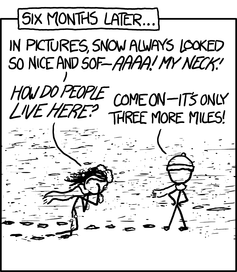
http://xkcd.com/192/


http://xkcd.com/1037/

Link to the original document: http://bit.ly/LYPWUB

Wednesday, October 2, 2013

Mysteries of the kingdom

I do not consider myself "old," but I have lived enough life to have seen a thing or two. In fact, I've seen enough to know and accept that I do not know everything. That does not mean it does not frustrate or needle me from time to time. I recently had a number of things happen which brought to the forefront some things I do not know.

In the context of my religion, things I do not know often fall under the realm of "mysteries of the kingdom." A lot of these things are really obscure and are often fodder for those who seek to discredit the church. When things fall into that category I might initially raise my eyebrows a bit, but in the end I find a way to make peace with it.

I feel the more interesting category surfaces only when an individual really understands and believes the gospel. As of right now I have three items in that category:

  1. Priesthood keys play a central role in the restoration, ministration, and administration of the LDS church, but what does that actually mean? What do keys give a person that the Priesthood or faith do not? Why don't all leadership roles in the church hold keys? Why do the ones that do hold keys need them? How does one exercise keys (as opposed to other forms of church leadership)?
  2. One of the recent triggering events I mentioned earlier was a blog post describing how Mormons don't understand the Atonement. I implies a very liberal and generous view, full of good feelings for everybody. That approach seems to get preached often in the church these days. How does that reconcile with the straight & narrow, gnashing of teeth, and all the other things which indicate a more narrow view?
  3. Elder Neal A Maxwell pointed out that the only thing we can really give God is our agency. That makes sense because He gives us everything. The problem then becomes one of destination. Consider the council in heaven. Heavenly Father presented a plan where we would come down to earth to learn how to be like him, and the way we would do that would be to subjugate the natural man and our will to the will of the Father. Then Satan got up and said that he'd take away our will and make us do the right thing. Success in either plan means giving up our will. A bit of a paradox.

At this point I don't really expect any satisfying answers for these three items. Then again, maybe something said in General Conference this weekend will address part of one of these.